
 Cart
 Orders

 Not available here
Product Overview
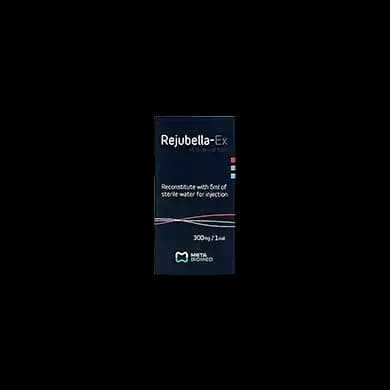
REJUBELLA-EX is a South Korean polydioxanone (PDO) collagen biostimulator manufactured by META BIOMED Co., Ltd. Formulated with 150 mg of biodegradable PDO microspheres and 150 mg of carboxymethylcellulose (CMC), REJUBELLA-EX contains a total of 300 mg of dry material per vial. Unlike conventional hyaluronic acid fillers or PLLA-based collagen stimulators, REJUBELLA-EX uses injectable PDO microspheres to support gradual collagen-associated tissue remodeling and temporary soft-tissue restoration.
REJUBELLA-EX is supplied as a sterile powder preparation intended to form a suspension before professional administration according to the manufacturer's instructions for use.
PDO is a biodegradable synthetic polymer widely recognized for its use in absorbable surgical sutures and aesthetic lifting threads. REJUBELLA-EX incorporates this material into a microsphere-based formulation rather than a conventional thread structure.
The manufacturer describes its PDO microspheres as having a predominantly spherical morphology and a relatively uniform particle-size distribution. Commercial technical materials report particle sizes of approximately 10–60 μm.
REJUBELLA-EX is registered in South Korea as a Class IV tissue-restoration medical device under MFDS permit number 20-171. Its documented intended purpose involves temporary restoration or reconstruction of facial and dermal tissue, including correction of wrinkles.
The standard commercial presentation contains one 300 mg vial per box. Each vial contains equal quantities of PDO and CMC, making the distinction between total powder weight and active polymer content particularly important.
This TEOSQUARE product page provides professional buyers with detailed information about REJUBELLA-EX, including its composition, PDO microsphere technology, collagen-biostimulation mechanism, packaging specifications, storage considerations, and regulatory status.
Key Features
- PDO Collagen Biostimulator: Contains polydioxanone microspheres, a biodegradable polymer material associated with collagen-related tissue remodeling.
- 150 mg PDO Microspheres: Each vial contains 150 mg of polydioxanone, the principal biodegradable polymer component.
- 150 mg Carboxymethylcellulose: Includes CMC as a supporting formulation ingredient associated with viscosity and suspension characteristics.
- 300 mg Total Powder Weight: The combined quantity of PDO and CMC is 300 mg per vial.
- Microsphere-Based PDO Technology: Uses spherical PDO particles rather than conventional absorbable PDO threads.
- Approximately 10–60 μm Particles: Commercial technical materials describe a relatively uniform PDO microsphere structure within this approximate size range.
- Biodegradable Polymer: PDO undergoes gradual hydrolytic degradation in biological environments.
- South Korean Medical Device: Manufactured by META BIOMED and registered in South Korea as a Class IV tissue-restoration medical device.
- Professional Vial Presentation: Supplied as a dry powder preparation, with one 300 mg vial per standard commercial box.
Composition & Specifications
REJUBELLA-EX contains two principal ingredients: polydioxanone (PDO) and carboxymethylcellulose (CMC).
The documented formulation contains 150 mg PDO and 150 mg CMC per vial, providing a total dry-powder weight of 300 mg.
PDO serves as the biodegradable polymer component, while CMC contributes to the physical characteristics of the formulation.
| Specification | Details |
|---|---|
| Product Name | REJUBELLA-EX |
| Alternative Name | Rejubella EX / Rejubella PDO Filler |
| Manufacturer | META BIOMED Co., Ltd. |
| Country of Origin | South Korea |
| Product Category | PDO Collagen Biostimulator / Tissue-Restoration Medical Device |
| Principal Polymer | Polydioxanone (PDO) |
| PDO Content | 150 mg/Vial |
| Supporting Ingredient | Carboxymethylcellulose (CMC) |
| CMC Content | 150 mg/Vial |
| Total Powder Weight | 300 mg/Vial |
| PDO-to-CMC Weight Ratio | 1:1 |
| PDO Material Type | Biodegradable Synthetic Polymer |
| PDO Particle Morphology | Microspherical |
| Reported Particle Size | Approximately 10–60 μm |
| Hyaluronic Acid | Not Included in the Declared Dry-Powder Composition |
| PLLA / PDLLA | Not Included in the Declared Composition |
| Lidocaine | Not Included in the Declared Dry-Powder Composition |
| Product Form | Sterile Powder for Suspension |
| Container | Vial |
| Standard Packaging | 1 Vial/Box |
| South Korean Device Classification | Class IV Tissue-Restoration Medical Device |
| MFDS Permit Number | 20-171 |
| Original Authorization Date | March 10, 2020 |
| Registered Device Category | Tissue-Restoration Material (B04230.02) |
| Intended Users | Qualified Healthcare Professionals |
Polydioxanone (PDO) — 150 mg
Polydioxanone is a biodegradable synthetic polymer belonging to the polyester family.
PDO has an established history of medical use, particularly in absorbable surgical sutures.
The material is also used in certain aesthetic lifting threads, where its biodegradable structure allows gradual absorption within biological tissues.
In REJUBELLA-EX, PDO is incorporated into microspheres rather than elongated surgical or lifting threads.
Each vial contains 150 mg of polydioxanone microspheres.
The manufacturer associates this particle-based formulation with gradual collagen-related tissue remodeling.
PDO undergoes hydrolytic degradation, during which its polymer chains gradually break down into smaller molecular components.
The resulting degradation products are subsequently processed through biological metabolic pathways.
However, the long-established use of PDO in surgical sutures does not automatically establish identical safety or clinical performance when the polymer is used as injectable microspheres.
Carboxymethylcellulose (CMC) — 150 mg
Carboxymethylcellulose is a water-soluble cellulose derivative widely used in pharmaceutical, biomedical, and formulation applications.
CMC is commonly used as a viscosity-modifying, thickening, and suspension-supporting ingredient.
REJUBELLA-EX contains 150 mg of CMC per vial.
When the product is prepared according to the manufacturer's instructions, CMC contributes to the physical characteristics of the suspension containing PDO microspheres.
Its formulation role is distinct from that of PDO, which is the principal biodegradable polymer associated with collagen biostimulation.
CMC should not be described as having the same biological mechanism as polydioxanone.
PDO and CMC — 1:1 Formulation
REJUBELLA-EX combines PDO and CMC in equal quantities by weight.
The formulation contains 150 mg PDO and 150 mg CMC, corresponding to a 1:1 weight ratio.
The total documented powder weight is 300 mg per vial.
This distinction is important because some distributor listings describe REJUBELLA-EX as containing 300 mg of PDO.
According to the consistently documented ingredient breakdown, the 300 mg specification represents the combined weight of PDO and CMC rather than 300 mg of pure polydioxanone.
REJUBELLA-EX contains 150 mg PDO and 150 mg CMC per vial. The product's 300 mg designation refers to their combined dry weight, not the PDO-only quantity or a prepared injection volume.
How REJUBELLA-EX PDO Biostimulation Works
REJUBELLA-EX is based on polydioxanone microspheres, a biodegradable polymer material associated with local tissue responses and collagen-related remodeling.
Its proposed mechanism differs from the immediate physical volume replacement associated with conventional cross-linked hyaluronic acid fillers.
PDO Microspheres and Tissue Interaction
PDO microspheres are biodegradable polymer particles that can interact with surrounding tissues following implantation.
Biomaterial implantation can initiate a localized tissue response involving immune cells, fibroblasts, and extracellular matrix components.
The character and intensity of this response depend on several factors, including the material's chemical composition, particle dimensions, surface characteristics, and the surrounding tissue environment.
META BIOMED describes its PDO microsphere technology as designed to support gradual tissue remodeling.
Fibroblast Activity and Collagen Formation
Fibroblasts are connective tissue cells responsible for producing collagen and other components of the extracellular matrix.
Collagen contributes to the mechanical strength and structural characteristics of skin and connective tissues.
Research involving biodegradable polymer implants, including PDO-based materials, has examined their relationship with fibroblast activity and collagen formation.
These findings provide a scientific rationale for the development of PDO-based collagen biostimulators.
However, evidence involving PDO sutures, threads, or other biodegradable implants cannot automatically establish the same degree of collagen formation from the finished REJUBELLA-EX microsphere formulation.
Gradual Soft-Tissue Remodeling
The manufacturer's commercial materials associate REJUBELLA-EX with progressive changes in skin firmness and soft-tissue volume.
These effects are commercially attributed to the interaction between biodegradable PDO particles and the surrounding tissue.
Changes in extracellular matrix composition may contribute to gradual improvements in tissue appearance.
The degree of improvement depends on the specific finished product, individual biological response, and other clinical factors.
Hydrolytic Degradation
Polydioxanone is designed to undergo gradual hydrolytic degradation.
Hydrolysis breaks down the polymer chains into smaller components that can undergo further biological processing.
This distinguishes PDO from permanent synthetic filling materials.
The degradation characteristics of injectable PDO microspheres should not automatically be assumed identical to those of PDO surgical sutures or lifting threads.
Similarly, the disappearance of polymer material does not independently establish how long an aesthetic improvement will remain visible.
The mechanisms described above are based on established properties of biodegradable PDO materials and the manufacturer's formulation concept. They do not guarantee a particular amount of collagen production, treatment duration, or clinical outcome with REJUBELLA-EX.
PDO Microsphere Technology
One of the distinguishing characteristics of REJUBELLA-EX is its use of polydioxanone microspheres.
META BIOMED has developed manufacturing technology associated with controlling the physical characteristics of PDO polymer particles.
Spherical Polymer Particles
REJUBELLA-EX is commercially described as containing predominantly spherical PDO particles.
The manufacturer emphasizes particle uniformity and relatively smooth surface characteristics in its technical presentation.
Particle shape can influence the physical behavior of particulate medical materials, including their suspension characteristics and interactions with surrounding tissue.
However, a spherical particle structure does not eliminate the possibility of inflammatory reactions, nodules, or other complications.
Particle Size — Approximately 10–60 μm
Commercial technical descriptions of REJUBELLA-EX identify a PDO particle-size range of approximately 10–60 micrometers.
A micrometer is one-thousandth of a millimeter.
Particle size and distribution are relevant quality characteristics for injectable polymer microspheres.
These characteristics may influence suspension behavior and the physical interaction between implanted particles and surrounding tissues.
The reported size range should be confirmed against the manufacturer's current technical specifications for the supplied product.
Manufacturer-Reported Microsphere Surface Area
META BIOMED's Rejubella technical leaflet discusses the collective surface area of its PDO microspheres.
The manufacturer uses this physical property to illustrate the difference between microsphere-based PDO materials and conventional PDO monofilaments.
Commercial materials describe approximately 2.6 million PDO microspheres and a calculated collective surface area of approximately 15,800 mm².
These figures represent manufacturer-reported physical characteristics and theoretical surface-area calculations.
They should not be interpreted as proof of equivalent lifting strength, collagen production, or clinical outcomes compared with any particular number of PDO threads.
PDO Polymer Processing
META BIOMED has publicly presented its proprietary PDO microsphere manufacturing approach in international medical aesthetics exhibitions.
Its commercial materials associate the technology with particle formation, particle-size consistency, and biodegradable polymer performance.
These material characteristics support product identification and technical evaluation.
Claims of reduced complication rates or superior clinical effectiveness require controlled studies involving the finished product.
Particle-size data, surface-area calculations, and manufacturing technology descriptions are material-level characteristics. They do not independently establish clinical superiority or a specific treatment result.
REJUBELLA-EX and Other Collagen Biostimulator Materials
REJUBELLA-EX belongs to the broader category of biodegradable injectable tissue-restoration materials.
However, not all collagen biostimulators contain the same polymer or operate through identical material characteristics.
PDO vs. PLLA
PDO stands for polydioxanone, while PLLA stands for poly-L-lactic acid.
Both are biodegradable synthetic polymers used in medical applications.
However, they have different chemical structures, degradation characteristics, and manufacturing requirements.
REJUBELLA-EX contains PDO rather than PLLA.
Clinical findings involving PLLA-based fillers should not automatically be attributed to PDO-based products.
PDO vs. PDLLA
PDLLA, or poly-D,L-lactic acid, is another biodegradable polymer used in certain collagen biostimulators.
Although PDO and PDLLA are both biodegradable polymers, their chemical composition and degradation behavior differ.
REJUBELLA-EX is not a PDLLA filler.
PDO Microspheres vs. PDO Threads
PDO lifting threads and PDO microsphere products share the same general polymer family but have different physical structures.
Lifting threads are elongated filament-based medical devices designed for specific tissue-support applications.
REJUBELLA-EX contains PDO in particulate microsphere form rather than continuous filaments.
As a result, the product should not be described as a direct substitute for the mechanical lifting action of PDO threads.
PDO Microspheres vs. Hyaluronic Acid Fillers
Conventional cross-linked hyaluronic acid fillers primarily provide temporary physical volume through a hydrated gel.
REJUBELLA-EX is a PDO microsphere formulation supported by CMC.
Its commercial collagen-biostimulation concept differs from that of conventional cross-linked HA fillers.
Hyaluronidase, which is used under appropriate medical circumstances to degrade hyaluronic acid, should not be assumed to dissolve PDO microspheres.
REJUBELLA-EX is a PDO-based medical device. Its formulation should not be confused with PLLA, PDLLA, cross-linked HA fillers, or conventional PDO lifting threads.
Intended Applications & Commercial Positioning
REJUBELLA-EX is registered in South Korea as a tissue-restoration medical device.
Its documented regulatory purpose involves temporary replacement, restoration, or reconstruction of dermal and facial tissue, including wrinkle correction.
Facial Wrinkles and Folds
Facial wrinkles and folds can develop through a combination of changes in skin structure, soft-tissue volume, elasticity, and facial anatomy.
REJUBELLA-EX is commercially positioned for temporary wrinkle correction and gradual collagen-associated tissue remodeling.
The material's intended function should be evaluated according to the manufacturer's authorized instructions for use.
Soft-Tissue Volume Restoration
Age-related changes in facial fat compartments, connective tissue, and underlying skeletal structures can influence facial contours.
REJUBELLA-EX is marketed for professional applications involving temporary restoration of selected facial soft-tissue volume deficits.
The extent and duration of any improvement depend on the product's finished formulation and individual biological factors.
Skin Firmness and Elasticity
Collagen is an important component of the dermal extracellular matrix.
Changes in collagen organization and connective tissue properties can influence the appearance of skin firmness and elasticity.
META BIOMED commercially positions its PDO microsphere technology around collagen-related tissue responses.
However, the presence of PDO does not independently establish a guaranteed increase in skin elasticity or a measurable lifting effect.
Other Aesthetic Applications
Some international distributors promote REJUBELLA-EX for additional aesthetic concerns, including skin texture, under-eye appearance, neck rejuvenation, and other facial contour applications.
These commercial descriptions should not automatically be interpreted as approved indications.
The suitability of the product for any particular anatomical area must be determined from the current manufacturer-issued instructions for use and applicable regulatory authorization.
The documented South Korean intended purpose concerns temporary dermal and facial tissue restoration. Additional marketed uses require separate clinical and regulatory consideration.
Packaging & Product Presentation
REJUBELLA-EX is supplied as a dry powder preparation containing PDO microspheres and CMC.
The standard commercial presentation contains one 300 mg vial per box.
| Packaging Component | Specification |
|---|---|
| Product Name | REJUBELLA-EX |
| Principal Polymer | Polydioxanone (PDO) |
| PDO Content | 150 mg/Vial |
| CMC Content | 150 mg/Vial |
| Total Powder Weight | 300 mg/Vial |
| Product Form | Dry Powder |
| Container Type | Vial |
| Standard Commercial Packaging | 1 Vial/Box |
| Manufacturer | META BIOMED Co., Ltd. |
| Country of Origin | South Korea |
300 mg Individual Vial
Each vial contains 150 mg PDO and 150 mg CMC.
The product is supplied in dry form rather than as a ready-to-use liquid syringe.
Professional preparation must follow the original manufacturer's instructions.
One-Vial Commercial Box
The standard documented packaging configuration contains one vial per box.
Certain international distributors offer multi-vial purchasing quantities or alternative commercial bundles.
Such distributor configurations should not automatically be interpreted as separate manufacturer packaging specifications.
Buyers should verify the exact product name, ingredient quantities, original label, batch number, expiration date, and manufacturer information.
The 300 mg figure represents total dry material per vial. It is not an injection volume or recommended administration quantity.
Storage & Handling
REJUBELLA-EX is supplied as a dry PDO microsphere formulation intended for professional preparation.
Commercial suppliers generally describe storage in a cool, dry environment protected from direct sunlight. Some distributors specify temperatures between 2°C and 25°C.
However, the exact manufacturer-validated storage conditions should be confirmed from the current original product labeling.
- Storage Temperature: Follow the validated temperature range stated in the original manufacturer-issued instructions.
- Moisture Protection: Protect the unopened dry preparation from inappropriate moisture exposure.
- Light Protection: Avoid direct sunlight and unsuitable environmental conditions.
- Original Packaging: Maintain the product in its original sealed manufacturer packaging.
- Container Integrity: Inspect the vial and packaging for damage or evidence of compromised sterility.
- Product Traceability: Verify the original product name, batch number, expiration date, and manufacturer information.
- Handling After Preparation: Follow the manufacturer's product-specific requirements for preparation, use, and disposal.
Shelf Life
Several international distributors report a shelf life of 24 months for REJUBELLA-EX.
However, the definitive shelf life should be confirmed from the current manufacturer-issued label and applicable regulatory documentation.
Prepared Suspension
Storage requirements for the unopened dry powder may differ from those applicable after preparation.
Published distributor instructions contain differing recommendations concerning the period during which a prepared suspension may be retained.
The permitted period after preparation should therefore not be determined from distributor information alone.
Manufacturer-issued storage and handling instructions take precedence over third-party descriptions. Do not assume that REJUBELLA-EX has the same preparation or storage requirements as PLLA, PDLLA, or other PDO products.
Safety & Regulatory Considerations
REJUBELLA-EX is an injectable tissue-restoration medical device intended for use by appropriately qualified healthcare professionals.
Clinical use requires consideration of patient-specific conditions, product characteristics, contraindications, and potential complications associated with biodegradable particulate implants.
Potential Adverse Reactions
Potential adverse reactions associated with injectable particulate fillers and collagen biostimulators include localized pain, swelling, redness, bruising, tenderness, and inflammation.
Additional complications may include infection, hypersensitivity reactions, persistent papules, subcutaneous nodules, and granulomatous inflammatory responses.
Some inflammatory reactions may develop after a delay rather than immediately following administration.
The specific frequency of these reactions for REJUBELLA-EX has not been independently established from comprehensive publicly available clinical safety data.
Vascular Complications
Injectable soft-tissue materials can cause serious complications if introduced into blood vessels.
Vascular obstruction may compromise tissue perfusion and lead to ischemia, tissue necrosis, or other severe injuries.
Depending on the anatomical region, serious complications may include visual impairment, blindness, or stroke.
Biodegradability and microsphere uniformity do not eliminate these risks.
Hypersensitivity and Patient Assessment
Known hypersensitivity to PDO, CMC, or other relevant formulation components is an important consideration.
Active infection or inflammation affecting a proposed treatment area may be a contraindication to administration.
Patients with relevant medical conditions, abnormal scarring tendencies, or a history of significant inflammatory reactions may require additional clinical assessment.
The safety of REJUBELLA-EX during pregnancy, breastfeeding, and in pediatric populations should be determined from the current manufacturer-issued instructions for use.
PDO Is Not Hyaluronic Acid
REJUBELLA-EX contains PDO rather than hyaluronic acid as its principal polymer.
Hyaluronidase is used under appropriate medical circumstances to degrade hyaluronic acid.
However, hyaluronidase should not be assumed to dissolve PDO microspheres.
Consequently, the management of complications associated with PDO-based products may differ from that of conventional HA fillers.
Clinical Evidence Limitations
PDO has an established history of use in absorbable medical devices, including surgical sutures.
Research involving PDO-based implants has examined tissue responses and collagen-associated remodeling.
However, findings involving PDO sutures or lifting threads do not automatically establish the safety and effectiveness of injectable PDO microspheres.
Certain distributor materials describe collagen-stimulation effects developing over several weeks and aesthetic results lasting up to approximately two years.
These commercial expectations should not be interpreted as guaranteed clinical outcomes or independently established duration claims for REJUBELLA-EX.
Claims of superior safety, absence of nodules, predictable collagen production, or permanent skin rejuvenation require appropriate product-specific evidence.
South Korean Medical Device Authorization
REJUBELLA-EX is registered in South Korea under MFDS permit number 20-171.
The original authorization date is March 10, 2020.
The device is classified as a Class IV tissue-restoration material under classification number B04230.02.
META BIOMED Co., Ltd. is identified as the South Korean manufacturing authorization holder.
The registered intended purpose involves temporary replacement, restoration, or reconstruction of facial and dermal tissue, including wrinkles.
The underlying regulatory record includes multiple product names and models. Buyers should verify that the supplied REJUBELLA-EX formulation corresponds to the applicable registered model and current labeling.
International Regulatory Considerations
South Korean medical device authorization does not automatically establish legal marketing authorization in other countries.
US FDA approval for REJUBELLA-EX has not been established.
FDA authorization of another PDO-containing medical device, including a surgical suture, does not automatically extend to an injectable PDO microsphere filler.
Likewise, certification or authorization of a different META BIOMED product does not establish current regulatory approval for REJUBELLA-EX.
Professional buyers should verify the exact product registration, legal manufacturer, approved intended use, import eligibility, and distribution requirements applicable to their destination market.
This information is intended for professional product identification and commercial evaluation. It does not provide preparation instructions, injection techniques, patient-specific treatment recommendations, or authorization for use outside applicable medical device regulations.
Frequently Asked Questions
What is REJUBELLA-EX?
REJUBELLA-EX is a South Korean PDO collagen biostimulator manufactured by META BIOMED. It contains 150 mg polydioxanone microspheres and 150 mg carboxymethylcellulose per vial, providing a total of 300 mg of dry material.
What are the main ingredients in REJUBELLA-EX?
The two principal ingredients are Polydioxanone (PDO) 150 mg and Carboxymethylcellulose (CMC) 150 mg per vial. PDO is the biodegradable polymer component, while CMC supports the physical characteristics of the prepared suspension.
Does REJUBELLA-EX contain 300 mg of PDO?
No. REJUBELLA-EX contains 150 mg PDO and 150 mg CMC. The combined dry-powder weight is 300 mg per vial. The total powder weight should not be confused with the amount of pure polydioxanone.
What is polydioxanone (PDO)?
Polydioxanone is a biodegradable synthetic polymer used in medical applications, particularly absorbable surgical sutures. REJUBELLA-EX incorporates PDO in microsphere form for its tissue-restoration and collagen-biostimulation formulation concept.
What is the role of CMC in REJUBELLA-EX?
Carboxymethylcellulose is a water-soluble cellulose derivative used as a viscosity-modifying and suspension-supporting ingredient. REJUBELLA-EX contains 150 mg CMC per vial to support the formulation's physical characteristics.
Is REJUBELLA-EX a PLLA or PDLLA filler?
No. REJUBELLA-EX contains polydioxanone (PDO), which is chemically different from PLLA and PDLLA. Clinical findings or treatment characteristics associated with PLA-based fillers should not automatically be attributed to REJUBELLA-EX.
Does REJUBELLA-EX contain hyaluronic acid?
No. Hyaluronic acid is not included in the declared dry-powder composition. The documented ingredients are PDO and CMC. REJUBELLA-EX should not be described as a conventional cross-linked HA filler.
Does REJUBELLA-EX contain lidocaine?
Lidocaine is not included in the documented original dry-powder composition. Any additional materials used during professional preparation must be consistent with the current manufacturer-issued instructions for use.
What is the particle size of REJUBELLA-EX?
Commercial technical materials describe PDO microspheres with an approximate particle-size range of 10–60 μm. The exact particle-size distribution should be confirmed from current manufacturer-controlled specifications for the supplied product.
How is REJUBELLA-EX different from PDO lifting threads?
Both use the biodegradable polymer polydioxanone, but their physical structures differ. PDO lifting threads are continuous filaments, while REJUBELLA-EX contains PDO microspheres. These products should not be considered mechanically or clinically interchangeable.
How many vials are included in one box?
The standard documented commercial package contains one 300 mg vial. Each vial contains 150 mg PDO and 150 mg CMC. Additional distributor purchasing configurations may be available.
Who manufactures REJUBELLA-EX?
REJUBELLA-EX is manufactured by META BIOMED Co., Ltd., a South Korean medical device manufacturer specializing in biodegradable polymer materials, surgical sutures, and other medical technologies.
Is REJUBELLA-EX approved in South Korea?
Yes. REJUBELLA-EX appears in a South Korean MFDS medical device authorization record under permit number 20-171, originally issued on March 10, 2020. The record classifies the product as a Class IV tissue-restoration material and identifies META BIOMED as the manufacturing authorization holder.
How should REJUBELLA-EX be stored?
Commercial suppliers generally recommend cool, dry storage away from direct sunlight, with some specifying 2–25°C. The definitive storage conditions and requirements after preparation should be confirmed from the manufacturer's original labeling.
How long do REJUBELLA-EX results last?
Some commercial distributors describe results lasting approximately 12–24 months. However, these estimates should not be treated as guaranteed outcomes. Independently verified product-specific clinical evidence is required to establish a reliable duration of effect.
Is REJUBELLA-EX FDA approved?
US FDA approval for REJUBELLA-EX has not been established. South Korean medical device authorization and approval of other PDO-containing products do not automatically establish authorization in the United States. Buyers should verify the product's legal status in their destination market.