
 Cart
 Orders

 Not available here
Product Overview
NABOTA is a South Korean botulinum toxin type A injectable medicine developed and manufactured by Daewoong Pharmaceutical Co., Ltd. Available in NABOTA 100 Units and NABOTA 200 Units, the product contains Clostridium botulinum toxin type A formulated with human serum albumin and sodium chloride. Both strengths are supplied as white to pale-yellow dried powder in single-dose glass vials and require refrigerated storage at 2–8°C.
NABOTA is a prescription neuromodulator that temporarily inhibits acetylcholine release at peripheral cholinergic nerve terminals. This mechanism reduces neuromuscular signaling and produces temporary relaxation of affected skeletal muscles.
Originally authorized in South Korea in 2013, NABOTA is manufactured using Daewoong's proprietary HI-PURE Technology. The manufacturer describes the product as a purified botulinum toxin type A complex produced through a patented purification process and vacuum-drying technology.
The NABOTA product family is marketed internationally under different commercial names. Related Daewoong-manufactured botulinum toxin products are marketed as JEUVEAU in the United States and NUCEIVA in selected European and other international markets. Their regulatory authorizations and market-specific formulations must be evaluated separately.
NABOTA 100U and 200U contain the same active ingredient but differ in their total labeled biological potency and excipient quantities per vial.
This TEOSQUARE product page covers NABOTA 100U and NABOTA 200U, providing professional buyers with information about composition, manufacturing technology, vial strengths, packaging, storage requirements, approved indications, and regulatory considerations.
Key Features
- Botulinum Toxin Type A: Contains Clostridium botulinum toxin type A, a neuromodulating protein that temporarily inhibits acetylcholine release at susceptible peripheral nerve terminals.
- 100U and 200U Strengths: Available in two commercial presentations containing 100 or 200 units of product-specific biological potency per vial.
- HI-PURE Technology: Manufactured using Daewoong's patented purification technology, developed to obtain a highly purified botulinum toxin complex.
- 900 kDa Toxin Complex: Daewoong describes NABOTA as a botulinum toxin type A complex with an approximate molecular size of 900 kDa.
- Vacuum-Dried Formulation: Uses a drying process developed to preserve the pharmaceutical characteristics of the toxin preparation during manufacturing.
- Human Serum Albumin and Sodium Chloride: Contains these two pharmaceutical excipients, with documented quantities that differ between the 100U and 200U formulations.
- Single-Vial Packaging: Both strengths are supplied in registered packages containing one vial per box.
- International Product Portfolio: Part of Daewoong's globally commercialized botulinum toxin portfolio, which includes the separately authorized JEUVEAU and NUCEIVA products.
Composition & Specifications
NABOTA contains Clostridium botulinum toxin type A as its active pharmaceutical ingredient. Human serum albumin and sodium chloride are included as excipients.
The two formulations share the same active ingredient but contain different quantities of botulinum toxin biological activity and supporting excipients.
| Specification | Details |
|---|---|
| Brand | NABOTA |
| Official Product Name | NABOTA Injection |
| Korean Product Name | 나보타주 / 나보타주200단위 |
| Product Category | Prescription Botulinum Toxin Type A Injectable Medicine |
| Active Ingredient | Clostridium Botulinum Toxin Type A |
| Available Strengths on This Page | 100 Units / 200 Units |
| Reported Toxin Complex Size | Approximately 900 kDa |
| Excipients | Human Serum Albumin and Sodium Chloride |
| Dosage Form | Dried Powder for Injection |
| Appearance | White to Pale-Yellow Dried Material in a Colorless Transparent Vial |
| Manufacturing Technology | HI-PURE Technology |
| Drying Technology | Vacuum Drying |
| Container Type | Glass Vial |
| Standard Packaging | 1 Vial per Box |
| Manufacturer | Daewoong Pharmaceutical Co., Ltd. |
| Country of Manufacture | South Korea |
| Storage Temperature | 2–8°C |
| Storage Container | Sealed Container |
| South Korean Classification | Prescription Biological Medicine |
| Intended Users | Authorized Healthcare Professionals |
Clostridium Botulinum Toxin Type A
Botulinum toxin type A is a neurotoxic protein produced by Clostridium botulinum. In pharmaceutical preparations, controlled quantities of the toxin are used to temporarily inhibit neurotransmitter release at susceptible nerve terminals.
The toxin acts on the cellular machinery responsible for acetylcholine release, reducing the transmission of signals from motor neurons to skeletal muscle fibers.
NABOTA contains botulinum toxin type A expressed in biological potency units. These units represent measured biological activity rather than the physical mass of the toxin.
The potency of NABOTA is determined through product-specific testing. Its units must not automatically be considered equivalent to those of BOTOX, Dysport, Xeomin, or other botulinum toxin preparations.
900 kDa Botulinum Toxin Complex
Botulinum toxin type A can exist in association with additional proteins, forming larger molecular complexes.
Daewoong describes NABOTA as containing a botulinum toxin type A complex with a molecular size of approximately 900 kDa.
The 900 kDa designation refers to the approximate molecular mass of the toxin-associated complex rather than the molecular mass of the enzymatically active neurotoxin alone.
The active neurotoxin component has a molecular mass of approximately 150 kDa and consists of heavy and light chains connected by a disulfide bond.
The manufacturer's descriptions of toxin complex size and purity are relevant to product characterization. However, molecular complex size alone does not establish clinical efficacy, diffusion characteristics, treatment duration, or immunogenicity.
Human Serum Albumin
Human serum albumin is a plasma-derived protein used as a stabilizing excipient in certain biological pharmaceutical formulations.
Albumin can help maintain protein stability during manufacturing, storage, and handling.
The South Korean product documentation identifies 0.5 mg of human serum albumin in NABOTA 100U and 1.0 mg in NABOTA 200U.
Because albumin is derived from human biological material, applicable product-specific safety information and manufacturing controls remain relevant.
Sodium Chloride
Sodium chloride is included as a pharmaceutical excipient contributing to the physicochemical characteristics of the formulation.
NABOTA 100U contains 0.9 mg sodium chloride per vial, while NABOTA 200U contains 1.8 mg.
These quantities are documented in South Korean pharmaceutical product information.
The composition described above applies to the South Korean NABOTA 100U and 200U formulations. Market-specific products distributed under other brand names may have separate approved specifications and should not be assumed identical without verification.
How NABOTA Botulinum Toxin Type A Works
NABOTA temporarily inhibits neuromuscular transmission through the pharmacological action of botulinum toxin type A.
The active neurotoxin interferes with the release of acetylcholine from peripheral cholinergic nerve terminals, producing temporary relaxation or weakness of affected skeletal muscles.
Normal Neuromuscular Transmission
Under normal physiological conditions, motor neurons release acetylcholine at the neuromuscular junction.
Acetylcholine binds to receptors on skeletal muscle cells, initiating the electrical events that lead to muscle contraction.
The release of acetylcholine depends on specialized proteins responsible for the fusion of neurotransmitter-containing vesicles with the nerve-terminal membrane.
SNAP-25 Cleavage
Botulinum toxin type A consists of a heavy chain and an enzymatically active light chain.
After interacting with susceptible nerve terminals, the toxin's light chain cleaves SNAP-25, a protein involved in the SNARE complex responsible for neurotransmitter vesicle fusion.
Disruption of SNAP-25 function reduces acetylcholine release into the neuromuscular junction.
As a result, the affected muscle receives fewer stimulatory signals from its motor nerve terminals.
Temporary Muscle Relaxation
Reduced acetylcholine release temporarily decreases neuromuscular signaling and muscle contraction.
In approved aesthetic applications, this mechanism can reduce the appearance of dynamic facial wrinkles associated with repeated muscle activity.
Dynamic wrinkles are lines that become more visible during facial expressions, such as frowning or smiling.
In certain therapeutic applications, the same mechanism can reduce excessive or involuntary muscle activity.
Recovery of Neuromuscular Function
The effects of botulinum toxin type A are temporary because neuromuscular function can gradually recover through biological processes involving nerve-terminal recovery and restoration of neurotransmission.
The onset, magnitude, and duration of clinical effects depend on the product formulation, approved indication, administration conditions, and individual patient characteristics.
A specific clinical duration should not be assumed for every indication or patient solely from the general pharmacological characteristics of botulinum toxin type A.
The mechanisms described above are established for botulinum toxin type A. They do not demonstrate identical potency, clinical performance, duration, or safety between NABOTA and other commercial botulinum toxin products.
Available NABOTA Variants
NABOTA is available in multiple registered strengths. This TEOSQUARE product group covers NABOTA 100 Units and NABOTA 200 Units.
Both formulations contain Clostridium botulinum toxin type A and are supplied as dried pharmaceutical preparations in individual glass vials.
Their primary differences are the total labeled biological potency and the quantities of human serum albumin and sodium chloride contained in each vial.
| Specification | NABOTA 100U | NABOTA 200U |
|---|---|---|
| Product Name | NABOTA Injection 100U | NABOTA Injection 200U |
| Active Ingredient | Botulinum Toxin Type A | Botulinum Toxin Type A |
| Labeled Potency | 100 Units | 200 Units |
| Human Serum Albumin | 0.5 mg | 1.0 mg |
| Sodium Chloride | 0.9 mg | 1.8 mg |
| Dosage Form | Dried Powder | Dried Powder |
| Container | Glass Vial | Glass Vial |
| Standard Packaging | 1 Vial per Box | 1 Vial per Box |
| Storage Temperature | 2–8°C | 2–8°C |
| Initial South Korean Authorization | November 29, 2013 | June 9, 2015 |
| Korean Product Authorization Code | 201310386 | 201503760 |
| Manufacturer | Daewoong Pharmaceutical | Daewoong Pharmaceutical |
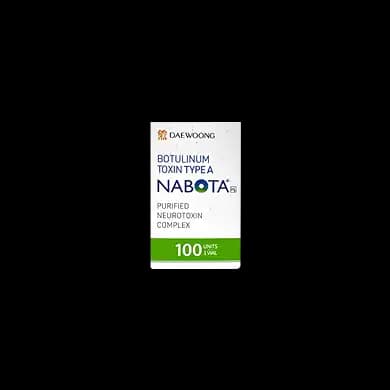
NABOTA 100 Units
NABOTA 100U contains 100 units of Clostridium botulinum toxin type A per vial.
The formulation includes 0.5 mg human serum albumin and 0.9 mg sodium chloride as pharmaceutical excipients.
NABOTA 100U is supplied as a white to pale-yellow vacuum-dried preparation in a transparent glass vial.
The product received its initial South Korean authorization on November 29, 2013, under pharmaceutical authorization code 201310386.
Its registered South Korean indications include selected aesthetic and therapeutic applications involving muscle-related conditions.
The current applicable prescribing information should be consulted to confirm the approved indications and professional-use requirements.
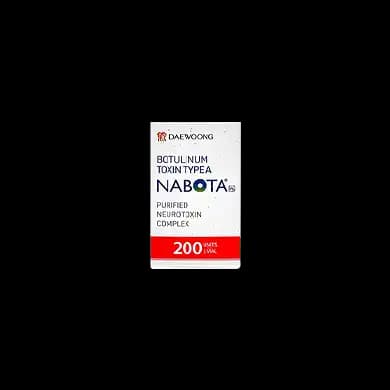
NABOTA 200 Units
NABOTA 200U contains 200 units of Clostridium botulinum toxin type A per vial.
Its formulation includes 1.0 mg human serum albumin and 1.8 mg sodium chloride.
NABOTA 200U is supplied as dried pharmaceutical material in a single-dose glass vial, with one vial per manufacturer box.
The product received its initial South Korean authorization on June 9, 2015, under pharmaceutical authorization code 201503760.
The 200U presentation provides twice the total labeled biological potency of NABOTA 100U.
This does not mean that each individual unit has greater potency, produces a stronger clinical effect, or has a longer duration of action.
NABOTA 100U and 200U are distinct pharmaceutical presentations with different labeled strengths. Product selection and clinical use must follow the applicable prescribing information. The quantities shown here are product specifications, not recommended administration doses.
HI-PURE Technology & Manufacturing Characteristics
NABOTA is manufactured using Daewoong's proprietary HI-PURE Technology, a patented process developed for the purification of botulinum toxin type A complexes.
The manufacturer describes this technology as a means of reducing process-related impurities and obtaining a highly purified toxin preparation.
HI-PURE Purification
Daewoong identifies HI-PURE Technology as a key manufacturing characteristic of NABOTA.
The company reports that its purification process produces a botulinum toxin complex with a purity exceeding 98% in relation to the specified 900 kDa complex.
This manufacturer-reported purity characteristic must be distinguished from the concentration of active toxin in the finished product and from its labeled biological potency.
A high reported purity percentage does not independently establish reduced immunogenicity, superior efficacy, or freedom from adverse reactions.
Vacuum-Drying Technology
Daewoong describes vacuum drying as part of the NABOTA manufacturing process.
Drying is used in certain biological pharmaceutical manufacturing processes to produce preparations suitable for storage before clinical use.
The manufacturer associates its process with the maintenance of toxin activity and product quality.
However, differences in manufacturing technology alone do not establish clinically meaningful superiority over another botulinum toxin formulation.
Product Quality and Biological Potency
Botulinum toxin pharmaceutical products require controlled manufacturing, formulation testing, and biological potency assessment.
NABOTA's labeled units describe biological activity measured through product-specific testing.
The manufacturer's purification process, toxin complex characteristics, and drying technology provide relevant product-identification information.
These characteristics should not be interpreted as proof of interchangeable potency or identical clinical performance across different commercial botulinum toxin brands.
HI-PURE Technology and the reported purity of the 900 kDa complex are manufacturer-described characteristics. Their presence does not guarantee faster onset, longer duration, lower antibody formation, or a reduced risk of complications for an individual patient.
Approved Indications & Regulatory Information
NABOTA is registered in South Korea as a prescription biological medicine containing Clostridium botulinum toxin type A.
The current South Korean product information for NABOTA includes both aesthetic and therapeutic indications.
Temporary Improvement of Glabellar Lines
NABOTA is approved in South Korea for the temporary improvement of moderate to severe glabellar lines associated with corrugator and/or procerus muscle activity in adults aged 20–65 years.
Glabellar lines are facial expression wrinkles that form between the eyebrows through repeated contraction of the associated muscles.
Temporary Improvement of Lateral Canthal Lines
NABOTA's South Korean labeling includes the temporary improvement of moderate to severe lateral canthal lines associated with orbicularis oculi muscle activity in adults aged 18–65 years.
Lateral canthal lines, commonly called crow's feet, are facial expression wrinkles that become more visible during smiling and other movements involving muscles around the eyes.
Temporary Improvement of Benign Masseter Muscle Hypertrophy
Current South Korean product information also includes the temporary improvement of marked to very marked benign masseter muscle hypertrophy in adults aged 18–65 years.
Masseter muscle hypertrophy refers to enlargement of the masseter muscles, which contribute to jaw movement and may influence the appearance of the lower face.
This indication is specific to the applicable South Korean registration and should not automatically be considered approved in other countries.
Post-Stroke Upper Limb Spasticity
NABOTA is also approved in South Korea for the treatment of focal upper limb spasticity associated with stroke in adults aged 18 years or older.
Spasticity is characterized by increased muscle tone and abnormal resistance to movement following neurological injury.
Benign Essential Blepharospasm
NABOTA's South Korean labeling includes treatment of benign essential blepharospasm in adults aged 18 years or older.
Blepharospasm is a neurological movement disorder characterized by involuntary contractions of muscles surrounding the eyes.
These indications are based on South Korean pharmaceutical information. Their authorization does not extend automatically to other markets. Product-specific prescribing information determines permitted uses, patient eligibility, contraindications, and clinical requirements.
NABOTA, JEUVEAU & NUCEIVA
NABOTA is part of Daewoong Pharmaceutical's internationally commercialized botulinum toxin type A portfolio.
Products originating from Daewoong's botulinum toxin technology are marketed under different brand names in selected international markets.
| Brand | Market | Regulatory Consideration |
|---|---|---|
| NABOTA | South Korea and Selected International Markets | Product Registration and Approved Indications Vary by Country |
| JEUVEAU | United States | FDA-Approved PrabotulinumtoxinA-xvfs Product with Its Own US Labeling |
| NUCEIVA | Europe and Selected International Markets | Separately Authorized Product with Market-Specific Labeling |
NABOTA
NABOTA is the original South Korean commercial brand developed by Daewoong Pharmaceutical.
The South Korean product family includes 100U and 200U formulations with separately documented pharmaceutical registrations.
JEUVEAU
JEUVEAU is a Daewoong-manufactured botulinum toxin type A product commercialized by Evolus in the United States.
JEUVEAU contains prabotulinumtoxinA-xvfs and received initial US FDA approval in February 2019.
The FDA-approved JEUVEAU presentation is a 100-unit prescription product indicated for the temporary improvement in the appearance of moderate to severe glabellar lines in adults.
This authorization is specific to the approved JEUVEAU product. It does not automatically authorize the importation or sale of South Korean-labeled NABOTA 100U or 200U in the United States.
NUCEIVA
NUCEIVA is a related Daewoong-manufactured botulinum toxin type A product marketed under a separate brand name in selected European and other international markets.
Its approved indications, strengths, packaging, and product documentation are determined by the regulatory authorities of the relevant market.
NUCEIVA's regulatory authorization should not be interpreted as blanket approval for every NABOTA formulation.
NABOTA, JEUVEAU, and NUCEIVA are commercially related products, but market-specific formulation specifications, approved labels, and regulatory authorizations must be verified independently. The existence of an FDA-approved JEUVEAU product does not establish FDA approval of NABOTA 200U.
Packaging & Product Presentation
NABOTA 100U and 200U are supplied as dried pharmaceutical preparations in individual colorless glass vials.
Both products are registered in South Korea with a standard packaging configuration of one vial per box.
| Packaging Component | NABOTA 100U | NABOTA 200U |
|---|---|---|
| Potency per Vial | 100 Units | 200 Units |
| Product Form | Dried Powder | Dried Powder |
| Container Type | Glass Vial | Glass Vial |
| Vials per Box | 1 | 1 |
| Human Serum Albumin | 0.5 mg | 1.0 mg |
| Sodium Chloride | 0.9 mg | 1.8 mg |
| Storage Temperature | 2–8°C | 2–8°C |
| Manufacturer | Daewoong Pharmaceutical | Daewoong Pharmaceutical |
| Country of Origin | South Korea | South Korea |
The labeled potency describes the biological activity of the dried product contained in each vial. It does not represent a liquid volume or recommended administration quantity.
Commercial distributors may offer multiple-vial purchasing quantities. Such offerings should not automatically be interpreted as original manufacturer box configurations.
Buyers should verify the product name, labeled potency, original manufacturer information, batch number, expiration date, and applicable pharmaceutical labeling before procurement.
Packaging specifications refer to the South Korean NABOTA products. Export-market presentations and related international brands may have different packaging or labeling requirements.
Storage & Handling
Daewoong Pharmaceutical's South Korean product information specifies refrigerated storage between 2°C and 8°C for unopened NABOTA 100U and 200U vials.
Both products should be maintained in sealed containers under the manufacturer-specified conditions.
- Refrigerated Storage: Store unopened vials at 2°C to 8°C.
- Temperature-Controlled Distribution: Maintain suitable refrigerated conditions throughout storage and transportation.
- Original Container: Keep the product in its original sealed vial and manufacturer packaging.
- Product Integrity: Inspect the original vial and packaging for visible damage or evidence of compromised integrity.
- Product Traceability: Verify the labeled strength, batch number, expiration date, manufacturer information, and applicable documentation.
- Professional Handling: Follow the product-specific official instructions for preparation, use, and disposal.
Storage requirements for a prepared solution are different from those for an unopened dried-powder vial.
The South Korean prescribing information permits refrigerated storage of the prepared product for a limited period under specified conditions. These requirements must be followed according to the official product-specific labeling.
The 2–8°C storage range applies to unopened NABOTA 100U and 200U under the South Korean pharmaceutical labeling. Do not assume that other botulinum toxin preparations have identical storage or handling requirements.
Safety & Regulatory Considerations
NABOTA is a prescription biological medicine containing botulinum toxin type A. Its use requires appropriate medical supervision and compliance with approved indications, contraindications, warnings, and national pharmaceutical regulations.
Potential Adverse Reactions
Adverse reactions associated with botulinum toxin type A products may include injection-site discomfort, bruising, swelling, headache, and unintended weakness of nearby muscles.
Depending on the indication and anatomical area, additional reactions may include eyelid ptosis, facial asymmetry, localized muscle weakness, or other functional changes.
The frequency and severity of adverse reactions depend on the specific product, indication, administration conditions, and patient-related factors.
Potential Spread of Toxin Effects
Botulinum toxin products may cause serious adverse reactions if their effects spread beyond the intended administration area.
Potential complications associated with this drug class include generalized muscle weakness, difficulty swallowing, speech disturbances, and breathing difficulties.
Such reactions may be life-threatening and require immediate medical evaluation.
Contraindications and Precautions
Patients with known hypersensitivity to botulinum toxin type A or relevant formulation components, or infection at the intended administration site, may have contraindications to treatment.
Certain neuromuscular disorders and concomitant medications affecting neuromuscular transmission may require additional precautions.
NABOTA contains human serum albumin, and the applicable safety considerations associated with human-derived biological excipients should be reviewed.
Non-Interchangeable Potency Units
Botulinum toxin biological potency units are determined through product-specific testing methods.
NABOTA units should not be directly converted into equivalent quantities of BOTOX, Dysport, Xeomin, or other botulinum toxin preparations.
Similar labeled unit counts do not establish identical clinical performance, duration, or safety profiles across different brands.
Immunogenicity and Treatment Response
Botulinum toxin products are biological medicines and may induce immune responses in some patients.
The development of neutralizing antibodies can potentially affect clinical response.
Daewoong's HI-PURE Technology is intended to reduce manufacturing-related impurities, but a high reported purity level does not independently guarantee the absence of antibody formation or treatment resistance.
Regulatory Authorization and International Distribution
NABOTA 100U and 200U are registered prescription medicines in South Korea.
Daewoong-manufactured botulinum toxin products also have regulatory approvals in selected international markets under different brand names, including JEUVEAU and NUCEIVA.
However, approval of JEUVEAU in the United States does not automatically establish FDA approval for South Korean-labeled NABOTA products.
The US FDA has specifically identified the online sale of a South Korean-labeled NABOTA product as an unauthorized drug offering. Accordingly, buyers must not assume that NABOTA 100U or 200U can be legally imported or purchased for clinical use in the United States.
Professional buyers should verify local marketing authorization, prescription requirements, import eligibility, distribution restrictions, and the regulatory status of the exact product presentation before procurement.
This information is intended for professional product identification and commercial evaluation. It does not provide administration instructions, establish patient suitability, replace official prescribing information, or authorize the distribution of prescription medicines outside applicable pharmaceutical regulations.
Frequently Asked Questions
What is NABOTA?
NABOTA is a South Korean prescription botulinum toxin type A injectable medicine developed and manufactured by Daewoong Pharmaceutical. It contains Clostridium botulinum toxin type A and is available in several strengths, including 100U and 200U.
What is the difference between NABOTA 100U and 200U?
NABOTA 100U contains 100 units of botulinum toxin type A, 0.5 mg human serum albumin, and 0.9 mg sodium chloride. NABOTA 200U contains 200 units of botulinum toxin type A, 1.0 mg human serum albumin, and 1.8 mg sodium chloride. Both are supplied as dried powder in single-dose vials.
Who manufactures NABOTA?
NABOTA is manufactured by Daewoong Pharmaceutical Co., Ltd. in South Korea. The product is developed using the company's proprietary HI-PURE Technology.
What is HI-PURE Technology?
HI-PURE Technology is Daewoong's patented purification technology for botulinum toxin type A. The company reports that the process produces a highly purified 900 kDa toxin complex, with a reported purity exceeding 98%. This manufacturing characteristic does not independently guarantee superior clinical performance or reduced immunogenicity.
Is NABOTA the same as JEUVEAU?
NABOTA and JEUVEAU are commercially related Daewoong-manufactured botulinum toxin products. JEUVEAU is a separately authorized prabotulinumtoxinA-xvfs medicine marketed in the United States. Its FDA approval does not automatically authorize the sale or importation of Korean-labeled NABOTA products.
What is the relationship between NABOTA and NUCEIVA?
NUCEIVA is a related Daewoong-manufactured botulinum toxin product marketed under a separate brand name in selected international markets. Product strengths, packaging, approved indications, and regulatory authorizations must be confirmed independently for each country.
Does NABOTA contain human serum albumin?
Yes. NABOTA 100U contains 0.5 mg human serum albumin, while NABOTA 200U contains 1.0 mg. Both formulations also contain sodium chloride as an excipient.
How many vials are included in one box of NABOTA?
Both NABOTA 100U and 200U are registered in South Korea with a standard packaging configuration of one vial per box. Commercial suppliers may offer multiple-vial purchasing quantities, which should not be confused with the original manufacturer packaging.
How should NABOTA be stored?
Unopened NABOTA 100U and 200U vials should be stored in sealed containers under refrigeration at 2°C to 8°C, according to the South Korean pharmaceutical labeling.
Are NABOTA units interchangeable with other botulinum toxin brands?
No. Botulinum toxin potency units are established using product-specific biological assays. NABOTA units should not be directly converted into equivalent quantities of other botulinum toxin products.
Is NABOTA FDA approved?
JEUVEAU, a related Daewoong-manufactured product, received US FDA approval in February 2019 as a 100-unit prescription botulinum toxin medicine for the temporary improvement of moderate to severe glabellar lines in adults. This approval does not automatically apply to South Korean-labeled NABOTA 100U or 200U. Buyers must verify the authorization and lawful distribution status of the exact product.