
 Cart
 Orders

 Not available here
Product Overview
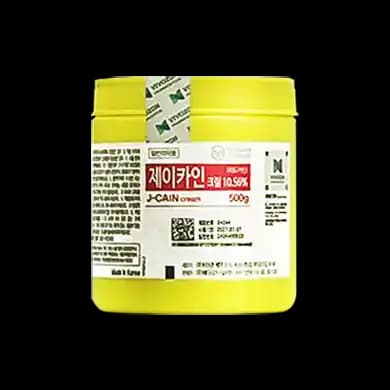
J-CAIN CREAM 10.56% is a Korean topical anesthetic cream formulated with lidocaine at a concentration of 105.6 mg/g. Manufactured by Vivozon Pharmaceutical Co., Ltd., this export-designated formulation is designed to produce localized anesthetic effects by temporarily reducing sensory nerve activity. It is commercially distributed in a 500 g container and is recognized in the medical aesthetics supply market as a high-concentration lidocaine cream.
J-CAIN CREAM belongs to the amide-type local anesthetic category and is intended for external topical application. Its pharmacological action makes lidocaine relevant to various clinical settings where localized sensory reduction is required. However, specific applications must comply with the product's approved indications and applicable national regulations. The Korean regulatory labeling for the 10.56% export formulation identifies reduction of penile tactile sensitivity as its stated indication; cosmetic procedural anesthesia should not be assumed to be an approved use.
Key Features
- 10.56% Lidocaine Concentration: Contains 105.6 mg of lidocaine per gram of cream, providing a clearly defined concentration for professional product assessment.
- Topical Local Anesthetic: Formulated with lidocaine, an amide-type anesthetic that temporarily inhibits sensory nerve impulse transmission.
- Cream Formulation: Supplied as a white to pale-yellow topical cream intended for external application according to its approved labeling.
- 500 g Commercial Presentation: Commonly distributed in a 500 g container. Buyers should verify the exact packaging configuration and labeling for their destination market.
- South Korean Pharmaceutical Product: The 10.56% export formulation is registered in South Korean pharmaceutical product information under Vivozon Pharmaceutical Co., Ltd.
Composition & Specifications
J-CAIN CREAM 10.56% is a single-active-ingredient topical anesthetic formulation. The following specifications refer to the 10.56% export-designated cream rather than the separately registered 9.6% formulation.
| Specification | Details |
|---|---|
| Product Name | J-CAIN CREAM 10.56% |
| Product Category | Topical Local Anesthetic |
| Active Ingredient | Lidocaine |
| Lidocaine Concentration | 10.56% w/w |
| Active Ingredient Content | 105.6 mg/g |
| Anesthetic Classification | Amide-Type Local Anesthetic |
| Formulation | Topical Cream |
| Appearance | White to Pale-Yellow Cream |
| Commercial Packaging | 500 g Container |
| Manufacturer | Vivozon Pharmaceutical Co., Ltd. |
| Country of Origin | South Korea |
| Application Route | External Topical Use |
| Storage Temperature | 1–30°C in a Tightly Closed Container |
| Korean Product Registration | 201206967 (Export-Designated Formulation) |
Formulation Components
In addition to lidocaine, the registered formulation lists excipients including glyceryl monostearate, methylparaben, isopropyl myristate, stearyl alcohol, ethanol, purified water, carbomer 940, polyoxyl 40 hydrogenated castor oil, and propylene glycol.
Ingredient information is based on the registered Korean export formulation. Exact packaging, labeling, and product presentation should be confirmed against the supplied unit.
How J-CAIN CREAM Works
The anesthetic activity of J-CAIN CREAM is associated with lidocaine, a well-established amide-type local anesthetic that acts on voltage-gated sodium channels in nerve cell membranes.
Under normal conditions, sodium channels allow sodium ions to enter nerve cells during electrical activation, supporting the generation and propagation of nerve impulses. Lidocaine reversibly inhibits these channels, reducing the ability of sensory nerves to transmit electrical signals.
This mechanism produces temporary localized sensory reduction in tissues exposed to an appropriate lidocaine formulation. The extent and duration of anesthesia depend on multiple factors, including formulation characteristics, application conditions, tissue properties, and individual responses.
The established pharmacology of lidocaine does not independently demonstrate a specific onset time, anesthetic duration, or clinical effectiveness for J-CAIN CREAM in cosmetic procedures. Such claims require product-specific evidence and authorization for the intended application.
J-CAIN CREAM Formulation Differences
Korean pharmaceutical records distinguish between the standard J-CAIN CREAM formulation containing 9.6% lidocaine and the export-designated J-CAIN CREAM 10.56%. These are separate registered formulations and should not be treated as identical products.
| Specification | J-CAIN CREAM 10.56% | J-CAIN CREAM 9.6% |
|---|---|---|
| Lidocaine Concentration | 10.56% | 9.6% |
| Lidocaine per Gram | 105.6 mg | 96 mg |
| Formulation | Topical Cream | Topical Cream |
| Korean Registration | 201206967 | 200401237 |
| Registration Designation | For Export | Standard Domestic Registration |
This comparison is provided to clarify product identification. It does not indicate that both formulations are offered on this TEOSQUARE product page or establish clinical interchangeability. Confirm the lidocaine percentage on the actual container before evaluating the product.
Storage & Handling
According to the Korean product registration, J-CAIN CREAM 10.56% should be stored in a tightly closed container at room temperature between 1°C and 30°C. Protect the product from direct sunlight and unsuitable temperature conditions.
- Temperature: Store between 1°C and 30°C according to the registered storage conditions.
- Container: Keep the container tightly closed when not in use.
- Environmental Protection: Avoid direct sunlight and exposure to excessive heat.
- Safety: Keep out of reach of children and prevent accidental exposure.
- Product Identification: Check the original container for the correct concentration, batch information, and expiration date.
Follow the instructions and storage requirements printed on the supplied product. Market-specific labeling may contain additional restrictions.
Safety & Regulatory Considerations
J-CAIN CREAM 10.56% contains a concentrated local anesthetic and must be handled in accordance with its approved labeling. Lidocaine can be absorbed systemically, and excessive exposure may cause serious adverse effects, including neurological and cardiovascular toxicity.
Individuals with known hypersensitivity to lidocaine or other amide-type local anesthetics must not use the product. The registered labeling also identifies restrictions involving damaged or inflamed application areas and specific patient circumstances.
The product contains propylene glycol and other excipients that may cause irritation or hypersensitivity reactions in susceptible individuals. The presence of a high lidocaine concentration should not be interpreted as evidence of superior safety, faster onset, or longer anesthetic duration.
Regulatory authorization, permitted indications, professional eligibility, and distribution requirements vary by country. The South Korean export designation does not establish marketing authorization or approval for cosmetic procedures in other jurisdictions.
This information is intended to support professional product identification and evaluation. It does not replace the official prescribing information, product labeling, or advice from a qualified healthcare professional.
Frequently Asked Questions
What is the lidocaine concentration in J-CAIN CREAM?
J-CAIN CREAM 10.56% contains 105.6 mg of lidocaine per gram of cream. This is equivalent to a concentration of 10.56% by weight. A separate 9.6% formulation is also listed in Korean pharmaceutical records.
Who manufactures J-CAIN CREAM?
The registered manufacturer of J-CAIN CREAM 10.56% is Vivozon Pharmaceutical Co., Ltd., a South Korean pharmaceutical company. Product documentation should be checked to confirm the manufacturer and labeling of the specific supplied batch.
What is the packaging size of J-CAIN CREAM?
J-CAIN CREAM 10.56% is commonly distributed in a 500 g container. Exact commercial packaging and labeling may vary by supplier and destination market. Buyers should confirm the supplied presentation before ordering.
How does lidocaine produce a numbing effect?
Lidocaine temporarily blocks voltage-gated sodium channels in nerve membranes. This reduces the generation and transmission of sensory nerve impulses, producing localized anesthetic effects.
Is J-CAIN CREAM 10.56% approved for cosmetic procedures?
The South Korean registration for J-CAIN CREAM 10.56% identifies reduction of penile tactile sensitivity as its labeled indication. This registration does not independently establish approval for cosmetic procedures, aesthetic injections, tattooing, or other applications. Permitted uses must be verified under the relevant country's regulations and product labeling.
How should J-CAIN CREAM be stored?
The registered storage conditions specify a tightly closed container at 1°C to 30°C. Keep the product away from direct sunlight and follow any additional instructions provided on the original packaging.